One of the less celebrated aspects of the “One Big Beautiful Bill (OBBB)” that was passed in 2025 was the creation of “Trump accounts”, a new custodial-style tax-advantaged retirement account created under IRS Code Section 530A. The accounts officially launched on July 4th, 2026, and individuals are now able to officially enroll eligible children.
This is likely one of the more significant additions to the financial planning landscape in 2026, but it has so far generated only occasional press or enthusiasm outside of the wealth management industry. But what are Trump accounts, and when can they make sense for individuals and families? As usual, there are some overlapping dynamics that will require careful consideration within the context of a family’s broader financial plan. We’ll spend some time helping to describe the ins and outs of these new savings options, and understanding where they might fit in alongside 529 plans, Roth IRAs, and other investment accounts.
How “Trump Accounts” work
Trump accounts are established as investment accounts for children under age 18 with a valid Social Security number. The accounts are designed to invest exclusively in diversified, low-cost U.S. stock index funds or ETFs, encouraging a focus on long-term investing while limiting speculative investment choices. Funds will generally remain invested until the beneficiary reaches adulthood, at which point the account is scheduled to transition to rules similar to those already governing traditional retirement accounts (IRAs). The primary attraction of these accounts is the “seed money” being offered by the Federal government, at least for a limited period of time. Per the provisions of the OBBB, children who are U.S. citizens and are (or were) born between January 1, 2025 and December 31, 2028 are eligible for a special, one-time $1,000 contribution from the U.S. Treasury, once the account is properly established.
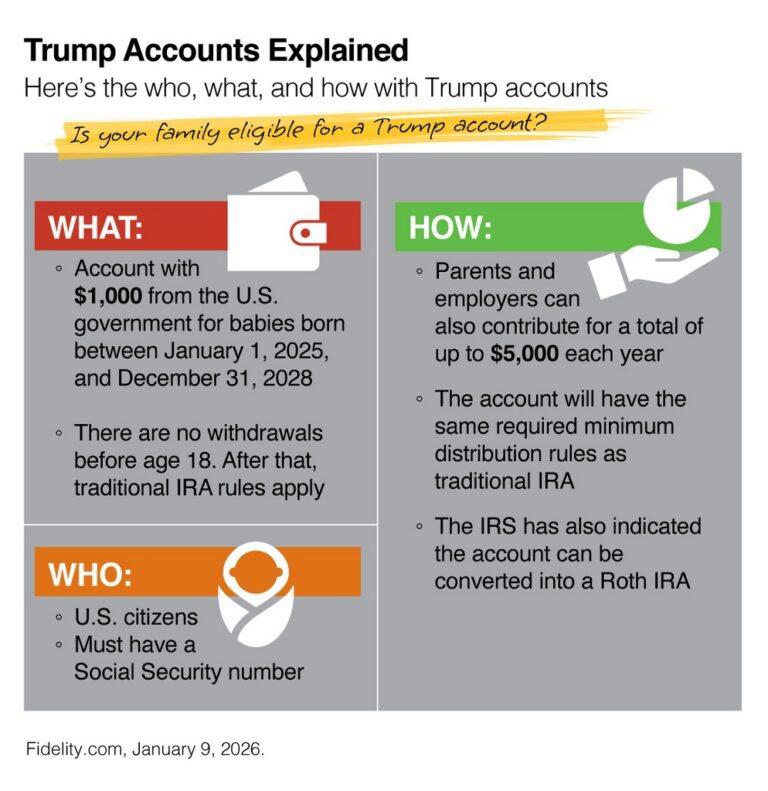
Families must elect to participate through the prescribed IRS process (generally speaking, the filing of Form 4547), either at tax filing time or at any time via the online enrollment system at TrumpAccounts.gov. Children born outside the prescribed four-year window will still be able to open a Trump account, but they will not be eligible for the initial $1,000 government contribution. Beyond the government contribution, additional deposits can be made by parents, grandparents, relatives, employers, charitable organizations, and even certain state-sponsored programs, subject to annual contribution limits that currently total $5,000 per child per year. Importantly, the initial $1,000 government “seed money” will not count against that annual contribution limit, and there are also certain limitations placed on how much any one donor may be allowed to contribute (employers, for example, can add up to $2,500 per employee, which will not be included as taxable income for the employee).
Interestingly, there has been a somewhat surprising amount of enthusiasm from employers, philanthropists, and others since these accounts were first announced, making these accounts even more attractive for certain individuals. More than 50 major companies have announced some level of matching funds (or direct contributions) to Trump accounts, including Goldman Sachs, Morgan Stanley, Bank of America, JPMorgan, Charles Schwab, BlackRock, Micron, Intel, SoFi, and many more. Those firms are typically matching the government’s initial $1,000 seed money, though some are also adding in matching programs for employee contributions. In addition, tech CEO Michael Dell and his wife Susan pledged to provide $6.25 billion to offer a $250 contribution to eligible children (aged 10 and under), provided they live in ZIP codes with median incomes of less than $150,000. This provides a benefit for up to 25 million children, and residents in more than 90% of U.S. counties should qualify.
When do these accounts make sense?
Whenever “free money” is available, it’s certainly worth paying attention. For families with eligible children, opening an account to receive the initial deposit is obviously an attractive opportunity, and there is no compelling reason to pass it up. Starting with a funded investment account at birth provides for potentially decades of compound growth, even if no additional contributions are made. For those qualifying for matching funds of some sort, the decision becomes even easier. For families who don’t qualify for the “seed money” contribution, though, the decision becomes much less clear-cut. While Trump accounts might provide for an attractive option for grandparents or other family members to contribute to a child’s long-term financial future (or just to serve as an introduction to investing for younger children), for most other purposes, existing investment options are at least as good, if not better.
For families who are particularly focused on funding higher education, 529 plans will typically remain the more tax-efficient option, since withdrawals from such plans are fully tax-free when used for qualifying expenses (whereas withdrawals from Trump accounts will be fully taxable as ordinary income). Many states also provide income tax deductions for contributions to these accounts, benefits that Trump accounts do not currently offer.
Similarly, families who are focused on funding their own retirement savings first should continue to prioritize contributions to their own employer plans, Health Savings Accounts (if eligible), and Roth IRAs before making any voluntary contributions to Trump accounts. Because their benefits are so limited, there isn’t much of a planning case to be made for Trump accounts as an ongoing destination for funds, at least under current law. Still, for young families who can get their “free money”, some quick attention is likely warranted. If you have any questions about Trump accounts and whether or not they make sense for you, we at Cypress are always here and ready to help.