On February 28th, the U.S. and Israel launched joint airstrikes across Iran, aiming to neutralize the nation’s nuclear program while also addressing other “imminent security threats”. The Supreme Leader Ayatollah Ali Khamenei was confirmed killed in the first wave of attacks, and Iran retaliated by striking oil and gas facilities in several different nations across the region, taking capacity offline and effectively shutting down transit through the all-important Strait of Hormuz, causing economic ripple effects throughout the region and world.
Since roughly a quarter of the world’s oil consumption passes through the Strait, the disruption to energy markets was swift and severe, with oil prices spiking substantially nearly overnight. Equity markets also took note, with both U.S. and international stocks quickly repricing risk as a new and uncertain outlook took hold. But what is the long-term impact of war on markets, historically? And what, if anything, might make this conflict different from its historical counterparts? We’ll discuss whether (and how) the current uncertainty impacts our outlook for the economy and markets, and what we’ll be watching over the coming weeks and months.
How do markets typically respond?
Ultimately, the vast majority of military conflicts have minimal impact on financial markets. There can often be an outsized reaction at the onset of the war, but markets tend to resume their prior trend fairly quickly. According to a recent report from LPL Financial, the average S&P 500 drawdown after what were deemed “major geopolitical events” is just 4.6%, which is well within the range of typical annual fluctuation. Furthermore, stocks typically recover those losses within about six weeks, so the typical duration of any impact is generally manageable. A year later, the picture is often quite good: the S&P 500 posted double-digit percentage gains in the 12 months following Pearl Harbor, the Cuban missile crisis, the Kennedy assassination, and, more recently, the start of the Israel-Hamas war.
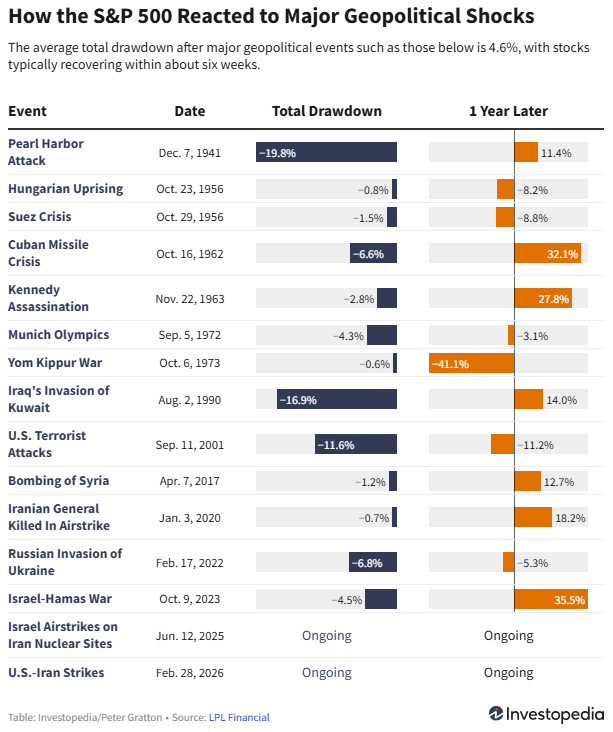
Obviously not all conflicts are the same, and there are certain historical instances in which the markets performed quite poorly. However, there is no compelling reason to believe that military conflicts, by themselves, cause markets to behave any differently than they normally do, in more peaceful times. Part of that market resilience can no doubt be attributed to the government response, with fiscal policies (and often monetary policy) typically aimed at counteracting any negative potential economic impacts that a war may cause. And it must at least be mentioned that increased military spending is, in the short term at least, somewhat stimulative to the economy. This was particularly true during World War II, when U.S. spending to fund the war effort and build up arms has been widely credited with helping to lift the nation out of the Great Depression.
At a time when military spending is already at all-time highs (as is our national debt), that stimulative effect is not what it once was, but it can still have an impact, at least in certain industries or sectors. The “industrials” sector (which includes the major aerospace/defense companies) only maintains about a 9% weighting in the now tech-heavy S&P 500, but strong growth in that sector can still provide a bulwark against volatility elsewhere in the economy and markets.
What could make this time different?
Of course, it bears mentioning that conflicts in economically sensitive areas must be considered somewhat differently, especially when oil-producing regions are involved. After all, transportation costs are a major input into just about every good and service provided in the American economy. It’s not simply the price that we all pay at the pump on a daily basis (leaving us less money in our pocket to invest and spend elsewhere in the economy), it’s the ripple effect on the cost side of every business that eventually flows through to consumer prices. At a time when the ongoing tariff conversation has already been weighing on investors’ minds—sparking concerns of another wave of inflation—adding an oil price shock to the mix probably isn’t the greatest thing for economic stability and certainty moving forward.
Memories from the “stagflation” episode of the 1970s and even the 1991 Gulf War, where major oil shocks severely disrupted the economy for an extended period, naturally reoccur every time there is a new conflict in the Middle East. However, those fears are largely misplaced, simply because the landscape of global energy markets has shifted so dramatically in recent decades. OPEC nations once controlled more than half of the world’s oil supply, but that figure has dropped to just about 35% today, and the International Energy Agency (IEA) suggests that rising non-OPEC production could push OPEC’s market share down near 30% by 2028. What’s more, much of that non-OPEC supply has a higher cost of production (including things like shale oil, offshore drilling, and oil sands), which means that they only become profitable when energy prices are relatively high. What that means, in effect, is that we here in the U.S. theoretically become less dependent on OPEC production, the higher the oil price goes. That can help put something of a lid on energy costs, recognizing that there is a bit of a circuit breaker built into global energy markets, allowing us to unlock new avenues of supply if and when oil prices are high. That new production won’t show up overnight (it normally will take at least 3 to 6 months to get to market, depending on method), but it can provide some important wiggle room once the short-term volatility has been managed. Of course, even short-term economic disruptions can be harmful, especially for lower-income workers who are least able to absorb the impact of higher fuel costs. A bit of geopolitical stability is always welcomed in markets, so a quick resolution to our current conflict is desirable.